

Table of Content
Testing for software quality assurance, whether functional or regression, can be a balancing act between two opposite demands – comprehensiveness and speed. In the case of complex systems and fast-paced development cycles, testing every functionality equally in every possible scenario is almost never feasible. Project teams therefore tend to either spread their testing efforts too thin or focus them too narrowly, leaving components under-tested and increasing the risk of costly defects, unnecessary delays, and reputational harm.
Risk-based testing offers a solution for optimizing limited time and resources by prioritizing testing based on the likelihood of potential failures and their impact on the business. Instead of treating all features equally, this sophisticated strategic approach allows you to direct testing efforts where they are needed most. Key components receive more immediate and thorough attention, while those with less impact on operations receive secondary coverage, and others can be safely ignored.
Panaya’s AI-powered change impact analysis automatically identifies which processes are affected by code or configuration changes, whether during development, patches, or customization. It then helps you generate an accurately scoped test plan that prioritizes activity according to business and technical risk. This targeted approach accelerates test cycles, reduces wasted effort, and allows QA teams to deliver high-quality software faster.
What You’ll Learn
- What risk-based testing (RBT) is, the problems and challenges of traditional QA testing, and what benefits the transition can bring to your business.
- The four core principles of risk-based testing and how they can be enhanced by AI-powered test automation.
- Risk-based testing replaces guesswork with data from change impact analysis, enabling smarter testing with automated prioritization of high-risk or mission-critical areas.
- Optimized resource allocation during change cycles, thanks to RBT, results in streamlined, data-driven testing that reduces risk, improves coverage, and supports faster, safer deployments.
- Panaya’s AI-driven change impact analysis for risk-based testing drives efficiency, precision, defect resolution speeds, delivery timelines, and scalability.
- There are specific QA testing pain points in SAP, Oracle, and Salesforce environments, all of which Panaya’s comprehensive solution addresses effectively.
Introduction: What Is Risk-Based Testing?
Risk-based testing (RBT) is a strategic approach to software quality assurance that prioritizes testing efforts based on business and technical risk. That is, focusing on those areas and processes where defects are most likely to occur and would have the greatest impact.
- Likelihood of failure: The probability of a defect occurring, based on factors like code complexity and integration touchpoints, developer familiarity with recent changes, historical defect density, and known test coverage gaps.
- Impact of failure: What the business or technical consequences would be if a defect reached production, taking into account potential financial loss, data breach, service disruption, system instability, and user dissatisfaction. High-risk areas of a business’s system – such as payment gateways, security modules, or data processing engines, for example – might receive deeper scrutiny than low-risk features.
RBT transforms testing from a checklist into a risk-informed decision-making process. By identifying and prioritizing areas of highest business and technical risk, organizations can direct limited resources more effectively and reduce the chance of serious defects reaching production. This targeted approach optimizes effort without sacrificing quality.
RBT is especially valuable in fast-paced development environments. By aligning testing priorities with business risk, teams can make smarter decisions under pressure, reduce unnecessary testing, and accelerate delivery of high-quality software. The result is a more agile, focused QA process that protects what matters most while minimizing wasted effort.
The Four Core Principles of Risk-Based Testing
There are four core principles of risk-based testing, which can also be enhanced by AI-powered test automation.
1. Risk Identification
Risk identification, the foundational step in risk-based testing, involves analyzing system or feature-level architecture, business requirements, historical defect data, and stakeholder input to pinpoint areas that are vulnerable to failure. Risks can arise from factors like complex code, third-party dependencies, and frequently modified components.
2. Risk Assessment
Once risks are identified, they must be evaluated in terms of their likelihood and potential impact. This assessment, assigning a score or categorizing each risk, helps prioritize which deserve the most attention. Factors to consider include how often a feature is used, the consequences of failure, and the ease of detection.
3. Test Prioritization
Test prioritization translates the risk assessment into actionable testing strategies, with resources allocated accordingly. Test cases are designed and organized so that those addressing high-risk issues are executed first and more frequently, ensuring that the most critical parts of the system are thoroughly validated even when time or resources are limited. Prioritization also guides decisions on which tests to automate, which to run in regression cycles, and which can be deferred.
4. Continuous Monitoring
As your system develops, new features are added, your business grows, and external conditions change, quality assurance risks evolve as well. Continuous monitoring ensures that the testing strategy remains aligned with current risk levels through tracking production incidents, analyzing user tickets, and reviewing test results. By maintaining an ongoing feedback loop, QA teams can adapt their testing efforts and revise outdated assumptions to promptly address emerging risks.
Applying the Principles: AI-Powered Test Automation
AI-powered test automation enhances each of these principles by introducing speed, intelligence, and adaptability. This includes automated test design and prioritization, targeting high-risk features and components. Finally, continuous monitoring is strengthened through AI’s ability to detect anomalies in production, correlate them with test results, and update risk models without manual intervention.
The Problem with Traditional Testing Approaches
Traditional, non-risk-based testing often treats all parts of a system with equal weight, leading to over-testing low-risk components and under-testing critical components. Test planning tends to rely on human intuition or legacy habits rather than data, which results in misaligned priorities and missed vulnerabilities. During change cycles – such as feature updates, bug fixes, or refactoring – this can create a major bottleneck, with QA teams spending excessive time revalidating stable features while draining resources that could be allocated to thoroughly testing high-risk processes. As a result, they inevitably have to skip certain tests to compensate for lost time.
Organizations using these approaches struggle with scalability, consistency, speed, and test scope coverage, adding to the risk they are trying to minimize and making it difficult to maintain reliability across complex systems. And where integrations and user behavior shift rapidly, emerging risks can go completely undetected without continuous monitoring or intelligent testing prioritization. The lack of automation compounds these problems, as test suites become bloated and costly, and manual testing consumes a lot of time and resources.
Risk-based testing powered by AI and automation fills this efficiency gap by enabling smarter test selection, prioritization based on current risk signals, and faster execution.
How Change Analysis Enables Smarter Testing
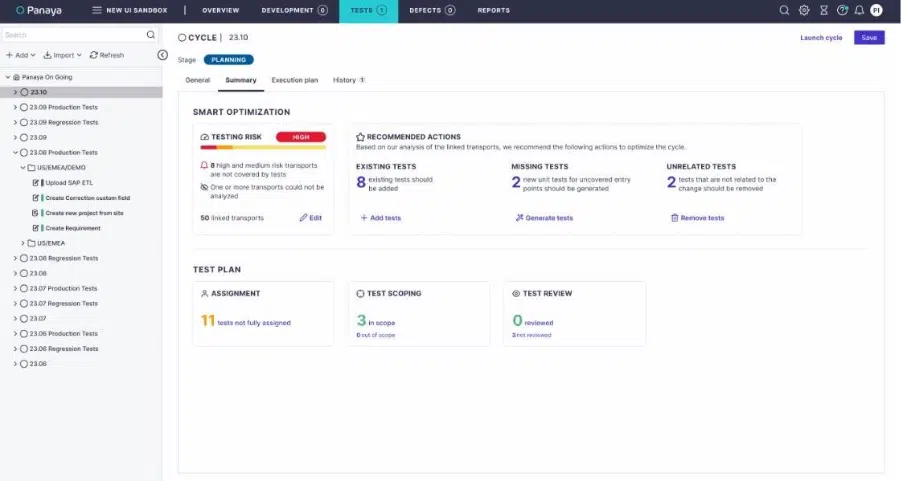
Identifying what needs to be tested – and just as importantly, what does not. That is the essence of Panaya’s change intelligence, which empowers organizations to test smarter during ERP and CRM updates. At the heart of this capability is Panaya’s automated change analysis engine, which scans code, configurations, and business processes to map the downstream impact of any update. By analyzing how changes propagate through interconnected modules, Panaya identifies the exact test scope required to validate system integrity.
An automatically generated report, indicating precisely which business processes will be impacted. Panaya provides a corresponding test and correction plan, allowing you to prioritize tests accordingly, create a test flow, assign testers, and specify data sets for reusable test cycles.
Impact-based testing then enables QA teams to focus on high-risk or mission-critical areas and confidently skip tests of unaffected functionality. This eliminates the need for blanket regression testing and helps minimize resource drain during change cycles. The result is a streamlined, data-driven testing strategy that reduces risk, improves coverage, and supports faster, safer deployments.
Risk-Based Testing: Replace Guesswork with Data-Driven Decisions
Relying on experience and assumptions alone during software testing can be a costly gamble. Manual prioritization often depends on tribal knowledge or outdated documentation, leaving blind spots that expose businesses to unnecessary risk. Failing to accurately identify the impact of a small code update on a Salesforce model, for example, can ultimately break a critical sales workflow. The fallout is lost revenue, frustrated users, a flood of support calls, and emergency fixes that drain resources.
Panaya eliminates this uncertainty by using real-time impact analysis to identify exactly which components are affected by each change. Instead of guessing, teams get a clear, data-backed roadmap of what to test and what can be safely ignored. Moreover, Panaya includes the necessary technical details of test scenario objects to enable automatic correlation between each change and the relevant test, eliminating the need for manual mapping. This precision reduces testing effort and ensures that high-risk areas are never overlooked, empowering businesses to make confident, informed decisions with every release.
Risk-Based Testing for SAP, Oracle, and Salesforce
In environments like SAP, Oracle, and Salesforce, where even minor changes can ripple across complex dependencies, Panaya’s guidance ensures that testing is both targeted and risk-aware.
SAP Pain Points
- High volume of transports during large-scale releases, making it difficult to track dependencies and assess risk across the landscape.
- Difficulty assessing impact of changes across multiple interconnected modules.
- Manual testing is massive, broad, and repetitive, consuming limited time and resources.
Oracle Pain Points
- Complex, multi-module EBS/cloud architecture makes change management tricky.
- Frequent patches and updates often trigger unexpected issues across systems and disrupt stability.
- Limited visibility into change impact, with teams struggling to predict what will break and where.
Salesforce Pain Points
- Frequent releases and sandbox refreshes make stability hard to maintain.
- Even minor updates can disrupt critical business logic, risking broken automations and workflows.
- Manual regression testing is unsustainable, as it is too time-consuming for fast-moving agile teams.
Panaya’s Solution
- Automatically analyzes each transport and individual change to detect impacted components, highlight change effects, and flag high-risk areas. This provides actionable insights pinpointing potential issues without workflow disruptions or extensive setup.
- Optimizes the test scope by intelligently selecting relevant cases based on change type, helping QA teams focus effort where it matters most while maintaining coverage across complex systems.
- Accelerates agile releases by reducing regression risk with change-aware testing and streamlined UAT cycles. This enables faster, safer go-lives with greater confidence and fewer surprises.
- Full integration with each environment enables seamless testing management and end-to-end coverage.

Panaya: Testing Efficiency and Quality Gains
Panaya delivers measurable ROI and quality gains by dramatically streamlining enterprise testing processes.
- Up to 85% reduction in test cycles, thanks to Panaya’s optimized scoping.
- Over 40% reduction in complexity, cost, and risk.
- 35% reduction in QA labor hours at Fujitsu.
- 72% reduction in post-go-live issues for Crane (a global leader in industrial products, aerospace, and electronics).
- Reduced redundant test cases and improved test coverage.
- Time and resource savings enabled QA teams to take on additional projects and other strategic initiatives.
An AI Guide on the Journey to Automated Testing
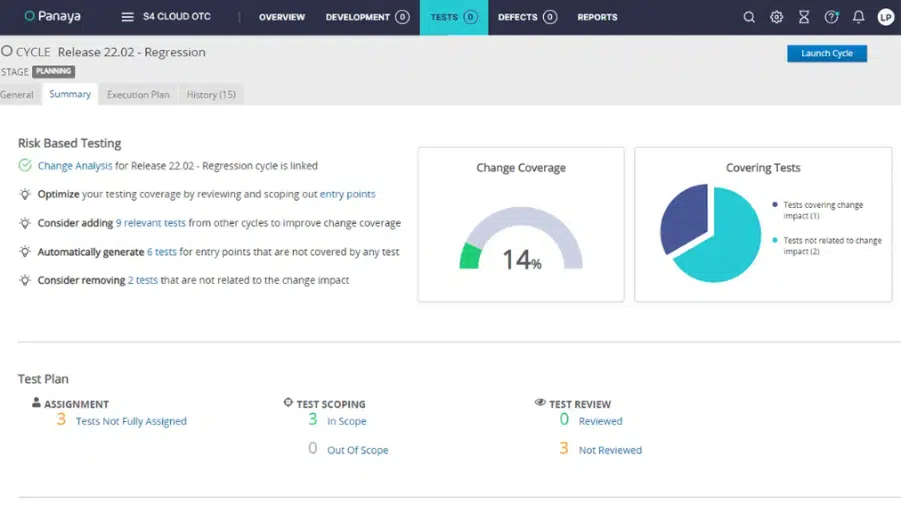
AI-powered testing platforms, such as Panaya, assess changes and associated risks, then automatically scope and generate the most relevant test cases. Testing is smarter, faster, and more focused when Panaya analyzes every change and its potential impact across your ERP or CRM landscape. This change-aware approach drives efficiency, precision, defect resolution speeds, delivery timelines, and scalability.
Panaya doesn’t offer a one-size-fits-all solution. Its AI-driven automation adapts to your environment, your processes, and your pace of change on a continuous basis, accelerating delivery, improving coverage, and enhancing software reliability without exhausting resources. Panaya has spent years refining its battle-tested platform across thousands of enterprise environments, helping organizations navigate upgrades, customizations, and digital transformations with confidence. With this deep domain expertise, Panaya understands both QA testing and the business processes it supports.
The practical benefits are clear. Customers routinely report reductions in testing cycles and labor-hours, freeing up teams to focus on innovation rather than maintenance. By automatically identifying the most relevant test cases and continuously adapting to system changes, Panaya minimizes risk while maximizing coverage. This is especially powerful in agile and DevOps environments, where rapid releases demand smarter prioritization, precision and speed.
Conclusion: Panaya’s Risk-Based Testing Approach
Risk-based testing transforms QA testing from a static, reactive chore into strategic change analysis. Panaya’s native integration of AI and automation takes risk-based testing to the next level, evolving with the software it protects in alignment with real operational needs.
You need to make sure your QA teams are testing the right things – and not spending time and resources testing things they shouldn’t. With Panaya, you can automate that risk analysis and generate an accurately scoped plan in a single place, reducing test cycles by 50%, cutting costs significantly, accelerating delivery, and increasing your testing ROI.
Key Takeaways
- Traditional QA wastes time: Without prioritization, teams over-test low-risk areas and miss critical ones.
- Manual prioritization is risky: Based on assumptions, tribal knowledge, and possibly outdated documentation, it leads to omission of important tests and overlooked code impacts. The result is broken workflows, lost revenue, user frustration, and costly fixes.
- Risk-based testing targets what matters: It pinpoints likely defect areas and evaluates their business impact.
- AI-guided risk-based testing automates precision: The Panaya platform provides a clear, data-rich map of which components are affected by each code or configuration change, with automatic scoping and generation of the most relevant test cases. QA teams know precisely what to test and what can be safely ignored.
- Built for agility and speed: Automated AI-guided risk-based testing is especially valuable in fast-paced agile development environments, enabling smarter decision-making under pressure and accelerating delivery of high-quality software.
- Proven results: Automated AI-guided risk-based drives efficiency, precision, defect resolution speeds, shorter go-live timelines, and scalability. Panaya customers have seen: up to 85% reduction in test cycles; over 40% reduction in complexity, costs, and risk; around 70% reduction in post-go-live issues; QA teams freed for more strategic initiatives; and more.
Final Thoughts
QA testing can be a strategic enabler, not a bottleneck, when you integrate risk-based testing and the full array of Panaya’s intelligent automation capabilities. The result is faster testing cycles with no compromise on quality. In fact, quite the opposite – the quality of your decision-making, testing effectiveness, and ERP change implementation will only improve.
The effect will be rapid, measurable, and clear, making it easy to demonstrate the ROI of AI-driven test automation to your organization’s business leaders.
Frequently Asked Questions