

Table of Content
Automation alone can no longer keep pace with the velocity of modern ERP change. Industry analyst Forrester notes that AI is pushing the industry towards more autonomous testing platforms, with platforms that will plan, learn, and act on their own.
The bar has been raised.
The question is no longer “Do you automate?”
It is “How intelligent is your automation?”
Modern teams expect systems to:
- Show exactly what changed
- Identify what is at risk
- Recommend what to test
- Explain why failures occurred
- Improve with every release
Modern teams need systems that automatically show what changed, identify risks, and recommend tests. Manual spreadsheets and human-led risk analysis are no longer sustainable in the face of exponentially increasing system complexity. Without an agentic layer to analyze problems and make informed decisions, organizations face escalating costs and production risks.
Traditional testing has become the primary bottleneck to digital transformation, and our clients are already seeing significant results by removing these manual obstacles.
One Panaya client, a global leader in endoscopic systems and medical technology, commented:
“After rolling out Seemore, one global testing team cut its Panaya support workload by 50%, reducing senior expert involvement from four hours a day to just two. With broader adoption, they expect to bring that down to one hour.”
What You’ll Learn
- Why traditional test automation can’t keep up with ERP change
- How Seemore adds intelligence that analyzes risk and drives action
- What sets Seemore apart from other testing tools, and why it matters
- How Seemore’s core capabilities work: Analyze, Test, Fix, and Guide
- How Seemore’s architecture ensures control, accuracy, and safety
- Real-world examples of Seemore cutting support load and onboarding time
Meet Seemore: Your Agentic Teammate
To escape the capacity trap, organizations need a force multiplier. Seemore is Panaya’s agentic layer, providing always-on, end-to-end intelligence. By understanding how requirements, transports, tests, defects, and fixes relate to each other, Seemore has the insights to act autonomously rather than just assisting.
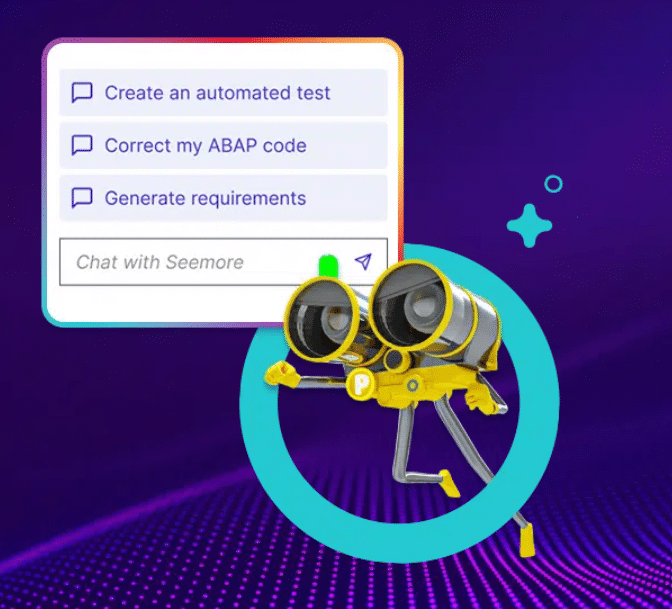
Seemore behaves like a 24/7 senior teammate who builds expertise without ever burning out. It eliminates repetitive analysis and preserves institutional knowledge within the platform, ensuring critical expertise stays in-house even when experts leave.
What Are Seemore’s Main Skills?
Seemore applies intelligence where it matters most: analyzing cross-system risk, generating codeless tests, detecting issues early, and guiding users step by step. With Seemore, teams know exactly what to test and when.
Analyze
Seemore sees the whole picture by running deep-impact assessments across enterprise systems. Whether analyzing the scope of a change or identifying risks, Seemore ensures teams have the insights needed to move forward.
Test
Seemore simplifies cumbersome traditional testing through smart, codeless test automation. It generates tests directly from natural language inputs, making it easy to scale coverage across multiple environments. This results in faster releases and fewer production issues.
Fix
Seemore proactively resolves issues. It detects anomalies in code, tests, and processes, then fixes them before they reach production. This autonomous approach minimizes downtime and reduces human error for greater reliability.
Guide
Seemore’s step-by-step guidance, powered by natural language processing, ensures users never get stuck. Whether onboarding new members or executing complex tasks, Seemore provides intuitive, context-driven instructions.
Seemore: Maximizing Team Efficiency and Speeding Up Results
Many enterprises face challenges related to resource limitations and project delays. Seemore overcomes these hurdles by offering a value proposition that multiplies team capacity and accelerates results.
Multiply Team Capacity Without Adding Headcount
You can now deliver more projects with less time and effort, effectively expanding your output without adding a single team member. Leverage the knowledge of your most experienced staff across every project to maintain quality even as you scale.
Reduce Time-to-Value and Reduce Project Friction
Reach critical project milestones faster from day one. By providing real-time, step-by-step instructions, Seemore speeds up the time-to-value for any initiative and reduces the friction typically associated with complex workflows.
Minimize Onboarding Friction
Boost user independence with AI-powered guidance, helping new team members navigate complex systems without constantly relying on your already-overloaded senior staff. This shortens the learning curve, allowing teams to focus on executing tasks rather than learning how to use the system.
Why Seemore Is Different: LLMs Guess, Seemore Knows
With some platforms, AI assistance is bolted on, but with Seemore, it’s built in. Seemore is different because it is tuned on three levels of deep context:
- ERP and CRM expertise
Grounded in 20 years of domain experience, Seemore “knows” typical objects and patterns for SAP, Oracle, Salesforce, and other business-critical applications. - Business context
Seemore doesn’t start from scratch. Upload your SAP system metadata to Panaya, and Seemore analyzes it to gain complete visibility into your unique system landscape from day one. Then, as you work, Seemore learns your specific processes and risk priorities, reflecting how your organization actually runs its order-to-cash or procure-to-pay flows. - Project context
Seemore runs requirements, development, testing, automation, and deployment on a single platform. It always knows which transport belongs to which requirement, which tests cover which flow, and which defects are still open. That end-to-end view is what makes it a trustworthy agent, and not just a feature.
These three layers of context allow Seemore to suggest and execute with precision in your specific environment.
Seemore’s Technological Backbone: Powering Intelligent Workflows
Seemore is built on a Claude-based agent architecture that orchestrates each user request through a secure, guided, multi-step workflow. It coordinates specialized agents and flows to handle tasks such as reasoning, retrieval, and secure tool execution, ensuring every interaction is controlled, accurate, and enterprise-ready.
- Structured Reasoning, Every Time: Each request spins up a fresh session with the correct context. Seemore then reasons through your task step by step, updating its understanding as new info appears.
- Workflow Discipline: Seemore doesn’t just suggest next steps; it guides users through them. From intent clarification to risk analysis to final action, it follows a predictable, auditable path.
- Persistent Memory: Seemore tracks session context over time, ensuring conversations stay coherent even as tasks evolve.
- Tightly Governed Action: Seemore interacts only with approved tools and datasets using an allowlist model. That means no surprises, no shadow access, and no drift from business policy.
This architecture ensures users get consistent, context-aware assistance without compromising control or accuracy.
RAG (Retrieval-Augmented Generation): Answers Grounded in Panaya Knowledge
To keep responses accurate and product-specific, Seemore uses Retrieval-Augmented Generation (RAG). With this approach, approved content is chunked, embedded, and stored in a dedicated vector database. This allows Seemore to retrieve the most relevant material from a trusted, semantically indexed resource library.
- Contextual Accuracy: Retrieved content is supplied to the model as grounding context, ensuring responses are based on what Panaya has documented.
- Precision and Currency: By grounding answers in approved source material, Seemore improves accuracy, reduces hallucinations, and stays aligned with the latest information.
- Dynamic Updates: When documentation changes, the index updates automatically, allowing Seemore to reference the latest content without retraining the model.
MCP Tools: Secure Connectors for Knowledge and Product Navigation
To deliver accurate guidance while limiting unnecessary access, Seemore uses MCP tools as tightly governed connectors.
- Frictionless Navigation: These tools allow the agent to retrieve curated knowledge via the RAG pipeline and generate navigation paths into relevant areas in Panaya. This enables users to move from “What should I do?” to “Take me there” with minimal friction.
- Governance and Control: Tool usage is explicitly controlled via an allowlist model where capabilities are granted intentionally at runtime.
- Enterprise Safety: Seemore limits access to approved tools, avoiding broad web access, arbitrary file operations, and uncontrolled execution, so high usability comes with the reassurance of strong governance.
By combining multi-step reasoning with retrieval from curated knowledge and secure tool-based actions, Seemore ensures that every interaction, from creating tests in natural language to troubleshooting issues, is delivered with accuracy, consistency, and enterprise-grade control. This foundation allows Seemore to scale across teams and projects, turning complex product questions into clear, actionable next steps.
Seemore In Action: Where Intelligence Meets Execution
Standard AI suggests; Seemore executes. Here are some examples of Seemore’s agentic features:
AI-Powered Code Corrections for ABAP coding
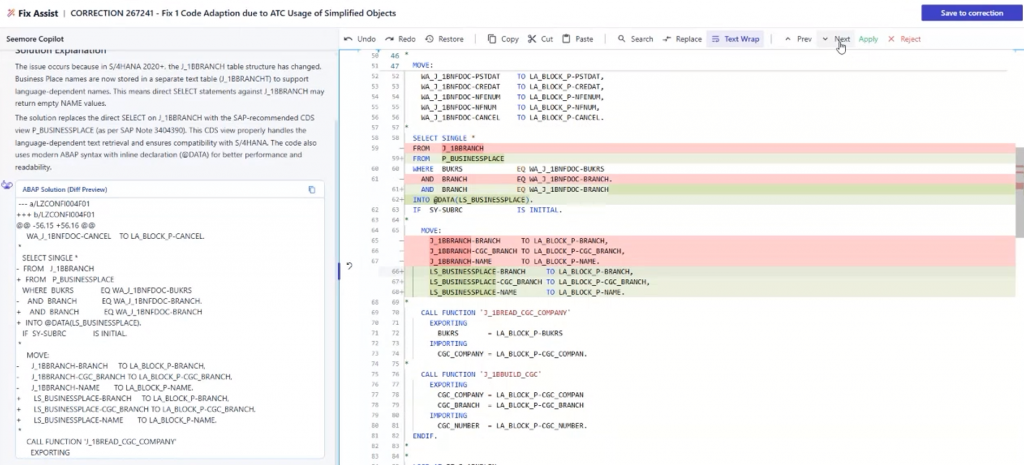
Seemore eliminates the massive custom code bottleneck in S/4HANA migrations by analyzing SAP system metadata and utilizing a LangGraph-based reasoning agent. This agent provides AI-generated suggestions for complex code cases that cannot be fixed automatically by Panaya. It interprets logic to provide actionable ABAP fixes and can instantly explain any ABAP code directly within the platform.
AI-Powered Functional Design Generation
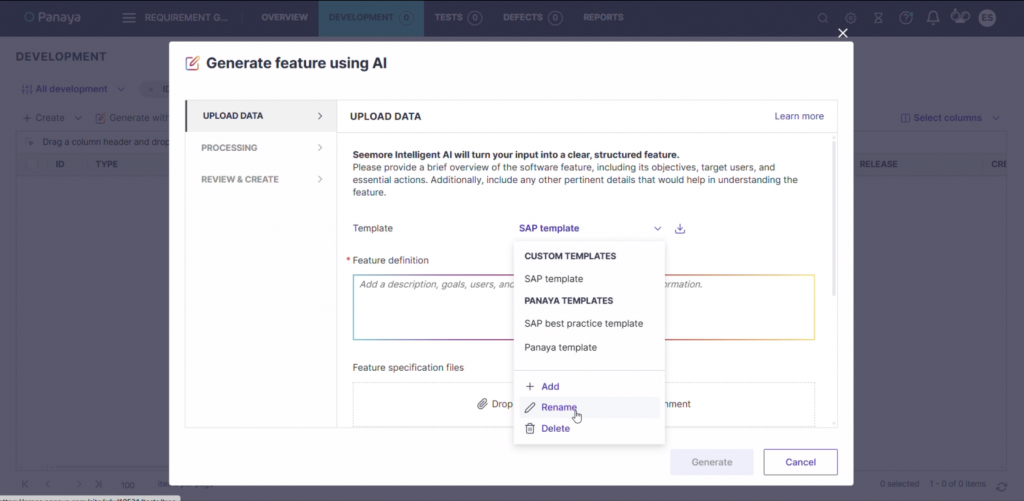
Manually creating requirements causes big delays. Seemore eliminates them by instantly transforming raw discovery data like interview notes and process maps into detailed technical specs. Using a specialized agentic flow, it generates functional designs at scale based on company templates to ensure cross-departmental alignment.
Multi-Source Automated Test Creation
Seemore instantly converts thousands of legacy manual tests into live automated scripts. Using an agent that interprets user intent, it applies reasoning to generate executable tests from other testing tools, free text, Excel, SAP best practices, requirement and manual evidence with zero extra effort. In short, it compresses months of manual effort into just hours of AI-driven execution, allowing teams to migrate and convert hundreds of assets into automated tests without losing productivity.

Real-World Use Cases
To understand the impact of an agentic layer, let’s look at how it handles the specific, high-pressure scenarios that SAP and CRM managers face daily. Seemore moves beyond simple search by understanding intent and orchestrating the necessary steps to resolve issues.
Intent Understanding: Routing Users to the Right Outcome
When a user types a prompt like, “My UAT is blocked after the upgrade,” Seemore doesn’t just provide a link to a manual; it recognizes their intent: troubleshooting.
- Targeted Follow-ups: It asks for specific details, such as the environment version or exactly where the block occurs.
- Guided Resolution: It then leads the user through the most likely resolution path, step by step, to unblock progress without the need to raise a support ticket and wait for assistance.
How-To Guidance: Without Opening a Ticket
Users often know what they want to achieve but aren’t sure of the exact Panaya workflow required. For example, a user might ask: “How do I validate the scope of changes before we move forward?”
- Structured Checklists: Instead of a generic answer, Seemore provides a structured checklist.
- Actionable Sequences: It recommends a specific sequence of actions aligned with Panaya’s best practices, turning a vague query into a clear project milestone.
Answers Grounded in Documented Sources
For critical configurations, such as setting up a testing scope for an SAP upgrade, accuracy is non-negotiable.
- Curated Retrieval: Seemore retrieves the most relevant guidance directly from the Panaya Success Center.
- Comprehensive Support: It provides documented steps, prerequisites, and common pitfalls, ensuring the user follows the “gold standard” of Panaya documentation with no need for slow manual searching.
Plain-Language Explanations of Platform Signals
Dashboard statuses can sometimes seem technical or ambiguous to occasional users. So, if a user asks, “What does this status mean in the dashboard?” Seemore acts as a translator.
- Plain Language: It pulls the official definition and explains it in accessible terms.
- Practical Implications: It details what the status means for the project and recommends the immediate next steps, so users can proceed with confidence.
Seemore transforms the platform into a guided assistant, providing immediate, actionable steps for any question. This empowers your team to act independently, while significantly cutting onboarding and support time.

Key Takeaways
For busy SAP and CRM managers, here are the core points to remember about how Seemore changes the transformation landscape:
- Agentic Efficiency: Move beyond one-shot prompts to multi-step, intelligent workflows that understand business intent.
- Grounded Accuracy: RAG-based responses ensure all technical answers are pulled directly from official Panaya documentation.
- Resource Optimization: Scale the expertise of your most senior staff to every user, effectively multiplying output without increasing headcount.
- Strategic Growth: Manage more concurrent projects and reach milestones faster by removing the traditional bottlenecks of manual testing and troubleshooting.
- Reduced Risk: Maintain business continuity by catching issues earlier and ensuring every action is aligned with your specific business context.
Frequently Asked Questions