


Table of Content
What You’ll Learn
- The necessity and benefits of migrating from SAP ECC to SAP S/4HANA.
- The challenges commonly faced during the SAP S/4HANA migration process.
- The three primary migration strategies: greenfield, brownfield, and hybrid transformation.
- Steps to choose the right migration approach and ensure a successful migration.
- Best practices for SAP migration to minimize risks and maximize efficiency.
- How Panaya can facilitate a smoother and more efficient SAP S/4HANA migration.
The End of SAP ECC: Time to Move Forward
Time is running out for organizations still operating on SAP ECC. With innovation accelerating across cloud infrastructure, AI-driven workflows, and customer-facing platforms, ECC’s legacy architecture can no longer support the speed and scale modern businesses require.
SAP has announced the end of mainstream maintenance for ECC in 2027, with premium extended maintenance available only until the end of 2030. Beyond that, organizations face limited support options on a platform that runs their most critical business processes.
At the same time, the external pressures are mounting:
- Shrinking support and rising technical debt: as more innovation is pushed to S/4HANA and cloud services.
- Escalating project costs: as thousands of SAP customers converge on similar timelines and compete for the same S/4HANA expertise.
- A global shortage of skilled S/4HANA resources: from solution architects and functional leads to migration and testing specialists.
Industry bodies such as ASUG and DSAG consistently warn that back-office systems must evolve if organizations expect to remain competitive. ECC might be stable today, but every year of delay increases the cost, complexity, and risk of tomorrow’s migration.
Pro tip: Act while you still have room to maneuver. Early assessment and planning are the only ways to secure the right partners, validate readiness, and build a migration roadmap that safeguards business continuity while delivering measurable value.
Why Migrate to SAP S/4HANA?
Moving to SAP S/4HANA is no longer a technology refresh, it’s a strategic upgrade that determines whether organizations can operate with the agility, resilience, and intelligence modern markets demand.
ECC’s architecture was not built for the scale of today’s data volumes, interconnected applications, real-time analytics, or AI-driven decision-making. S/4HANA, by contrast, is SAP’s innovation engine: the platform where new capabilities, automation features, and long-term enhancements are delivered first.
Three forces make early migration essential:
- Innovation is shifting away from ECC: SAP’s roadmap concentrates new capabilities, from embedded analytics to AI automation, on S/4HANA and cloud services. Staying on ECC means falling further behind each year.
- The clean-core era is here, and organizations are expected to reduce custom code, adopt standard processes, and use SAP BTP for extensions. This model delivers faster upgrades, fewer regressions, and lower long-term ownership costs.
- The window for low-risk migration is narrowing as 2027 approaches, talent, SI capacity, and migration tooling are becoming bottlenecks. Early movers secure better pricing, dedicated teams, and more predictable timelines.
Moving to SAP S/4HANA is essential for any organization that wants to stay competitive. The platform delivers real-time insights, faster processing, and streamlined operations that ECC simply cannot match. With its in-memory engine and modern architecture, S/4HANA empowers leaders to make smarter decisions and run more agile, efficient businesses.
Equally important, S/4HANA is the gateway to SAP’s latest innovations: AI, automation, predictive analytics, and next-generation user experiences. Organizations that move early gain the advantage; those that wait risk higher costs, greater complexity, and limited access to talent as 2027 approaches.
Pro tip: The sooner you move, the more control you keep over scope, cost, risk, and outcomes. Waiting forces your organization into the same crowded resource market as everyone else.
What are the Benefits of a S/4HANA Migration?
SAP S/4HANA delivers tangible, measurable improvements across performance, usability, operations, and strategic decision-making. These are the benefits that consistently matter most to CIOs, Finance leaders, and COE managers:
- Real-Time Insights and Embedded Analytics: S/4HANA’s in-memory architecture and simplified data model enable instant reporting without relying on separate BW layers. Operational leaders gain faster period-end closes, real-time profitability views, and insight into bottlenecks across the supply chain.
- Modern User Experience with SAP Fiori: The adoption of SAP Fiori moves organizations away from the legacy GUI experience. Business users gain role-based, intuitive apps that reduce training time, increase adoption, and support mobility. This accelerates productivity across every module.
- Streamlined Processes and a Clean Core: S/4HANA consolidates and modernizes core processes. Its “clean core” architecture reduces technical debt, eliminates redundant customizations, and stabilizes future upgrades: a critical factor for organizations seeking predictable change cycles.
- AI, Automation, and Extensibility via SAP BTP: S/4HANA is SAP’s gateway to next-generation innovation:
- AI-assisted finance and supply chain insights (with more coming)
- Predictive analytics
- Extensibility on SAP BTP without modifying the core
This foundation enables continuous improvement rather than large, disruptive upgrades.
- Faster Performance and Reduced Footprint: The universal journal, simplified tables, and in-memory processing significantly accelerate transactions and analytics. Organizations benefit from a lower data footprint, reduced infrastructure complexity, and improved operational efficiency.
- Future-Proof Architecture: S/4HANA aligns with SAP’s long-term roadmap. As new capabilities, frameworks, and industry innovations arrive, they will be developed for S/4HANA only. ECC environments will increasingly fall behind on performance, automation, and compliance readiness.
Pro tip: Migrating to S/4HANA isn’t only about what you gain today; it’s about ensuring your business is ready for the operating models, AI-driven workflows, and automation standards that will define the next decade.
SAP Migration to S/4HANA: State of the Market
The global shift toward SAP S/4HANA is accelerating, but most organizations are still early in their journey. According to SAPinsider, more than half (52%) of companies remain in the evaluation phase, aware of the urgency but not yet executing on a migration strategy. This creates a rapidly tightening window as ECC’s 2027 deadline approaches.
Panaya’s conversations with customers across manufacturing, retail, consumer goods, pharmaceuticals, and logistics reveal the same pattern:
- Most organizations expect to follow a Brownfield/Hybrid path, preserving existing processes while moving to S/4HANA.
- The highest-friction stage is the evaluation and business-case phase, where uncertainty around scope, effort, cost, and risk slows executive decision-making.
- Resource constraints are now one of the biggest barriers: S/4HANA architects, functional experts, and test leads are increasingly difficult to secure.
This aligns with recent ASUG and DSAG findings: complexity, lack of internal expertise, and planning uncertainty remain top blockers. But the context has changed, in 2025, the barrier is no longer whether to migrate, but how to do it without disrupting the business or overstretching IT capacity.
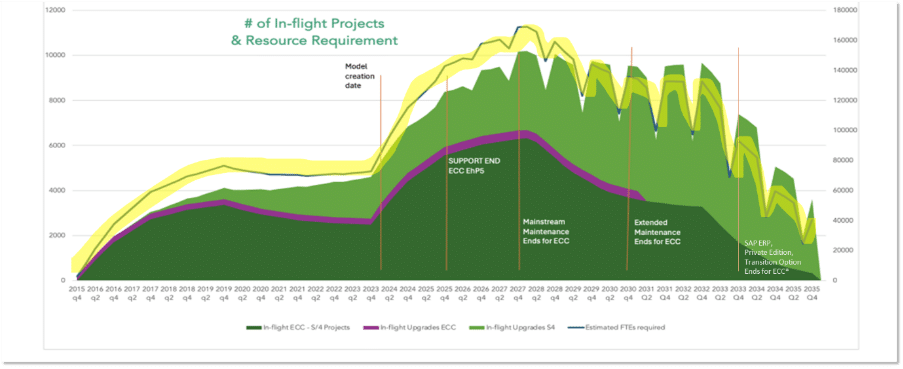
This chart shows a steep rise in global SAP S/4HANA migration activity leading up to SAP’s 2027 and 2030 ECC support deadlines and illustrates that resource demand will dramatically exceed supply, creating a global delivery bottleneck that will impact costs, timelines, and project risk – source.
Pro tip: Strategy, readiness, and scoping have become the new currency. The organizations that invest early in real assessments: usage-based, risk-based, and process-based, gain clarity and move faster with fewer surprises.

What Has Changed? The New Migration Pressure
While many of the traditional migration challenges still apply (data and archiving complexity, rising costs and shrinking budgets, etc.), 2025 introduces new pressures that fundamentally change the shape of S/4HANA programs:
- Compressed timelines: companies that waited for clarity on RISE, deployment models, or SAP’s roadmap now face less than two years of mainstream ECC support, leading to accelerated planning and sequencing.
- Customization overload: Many ECC environments rely heavily on custom code that won’t run natively in S/4HANA. Determining what to redesign or retire is critical; and the rise of the clean-core mandates organizations reevaluate custom code, extensions, and modifications. Heavy Z-code footprints now translate directly into higher migration cost, longer testing cycles, and more regression risk. Custom code challenges account for >30% of the project scope.
- SI and talent scarcity: as global demand spikes, experienced S/4HANA architects, functional leads, and testing specialists are becoming harder to secure, and more expensive.
- Integration complexity across hybrid landscapes: most enterprises now operate SAP + cloud + SaaS ecosystems. Ensuring end-to-end process continuity requires significantly more integration analysis and testing than ECC-era upgrades.
- Higher expectations for analytics, automation, and AI-readiness: business executives expect immediate value from S/4HANA. This raises the bar on what a migration must deliver: redesigned processes, automation opportunities, real-time visibility, and a platform fit for AI workflows.
These forces make “late migrations” significantly more risky, expensive, and resource-intensive.
Learn all about the 5 common mistakes ECC customers make when planning their SAP S/4HANA Migration.
S/4HANA Migration Strategies: Greenfield, Brownfield, and What’s in Between (Hybrid/SDT)
There is no single “right” way to migrate to SAP S/4HANA. The best approach depends on your processes, customizations, data footprint, cloud strategy, and readiness for change. In 2025, most organizations choose among three proven paths:
- Greenfield – New Implementation
- Brownfield – System Conversion
- Hybrid / Selective Data Transition (SDT)
Greenfield: A Fresh Start
A greenfield approach is a completely new implementation of your SAP ERP landscape using S/4HANA best practices. It is ideal for organizations with highly customized ECC systems, outdated processes, or significant organizational change on the horizon. The radical changes inevitably introduced in how you operate the system can be unnerving. And the implementation process can be tiresome and time-consuming, especially on the change management side. So, before you go down the greenfield path, be sure you’re ready for an intense and involved re-engineering process.
Advantages:
- Adopt modern, streamlined business processes aligned with SAP best practices
- Reduce technical debt and remove unnecessary customizations
- Enable a true clean-core architecture from day one
Considerations:
- Can require extensive change management
- Higher upfront effort and investment compared to Brownfield
Greenfield offers a powerful opportunity to reset and modernize operations but demands strong governance and a readiness for organizational change.
Brownfield: Preserve and Transform
A brownfield migration converts your existing ECC system(s) into S/4HANA while preserving core business processes, configurations, and historical data. This is a strong choice for mature organizations that want continuity with less operational disruption.
Advantages:
- Faster adoption and lower disruption compared to Greenfield
- Retain process knowledge and existing data structures
- Minimize change-management impact to the business
- Can be executed in staged waves or phased rollouts
Considerations:
- Custom code (Z-code) must be remediated to meet S/4HANA compatibility
- Not all existing processes map cleanly into S/4HANA’s simplified data model
- May retain legacy complexity if not paired with simplification decisions
Brownfield is a practical path for companies that want the benefits of S/4HANA without a full reinvention, but only if custom-code remediation, regression testing, and simplification work are addressed early.
Hybrid / Selective Data Transition (SDT): The Flexible Middle Path
Hybrid migration, often delivered as Selective Data Transition (SDT), combines elements of Greenfield and Brownfield. It is designed for organizations that want transformation without abandoning valuable assets.
Advantages:
- Selectively move processes, company codes, or business units to S/4HANA
- Consolidate multiple ECC systems into a single S/4HANA landscape
- Retain historical data where needed, while redesigning targeted processes
- Gradual transformation with lower operational risk
Considerations:
- Requires experienced partners and structured tooling
- More complex scoping and sequencing than a pure Brownfield or Greenfield
- Thorough testing is required due to mixed-model transitions
Hybrid / SDT has quickly become a preferred option for complex global businesses, especially those with multi-system landscapes or M&A-driven ERP histories.
Pro tip: Your S/4HANA deployment model is a strategic decision that affects cost, flexibility, upgrade cycles, and integration complexity. Clarifying your deployment model early ensures the right architectural decisions, testing strategy, and code-remediation scope, dramatically reducing late-stage rework.
The Key Steps to a Successful SAP S/4HANA Migration
Every S/4HANA program must follow a structured, traceable, and well-governed sequence of activities. SAP Activate provides the overarching methodology, but the depth of preparation (data, custom code, integrations, and testing) determines whether your project stays on budget and on schedule.
Greenfield: SAP Activate Done Right
The Greenfield pathway uses the SAP Activate framework end-to-end. In 2025, this approach matters more than ever because it supports clean-core principles, reduced customization, and faster upgrade cycles.
- Discover: Identify the business value you expect from S/4HANA and define the roadmap that will guide the implementation. This phase sets expectations and ensures alignment across business and IT.
- Prepare: Finalize project plans, assemble your team, and confirm scope. The focus here is ensuring that the right people, tools, and environments are in place before major work begins.
- Explore (Fit-to-Standard): Instead of traditional blueprinting, SAP Activate uses Fit/Gap analysis. You evaluate how standard S/4HANA processes match your needs and identify where adjustments are required. This speeds decision-making and reduces unnecessary customization.
- Realize: Configure the system, integrate with external applications, migrate data, and set up reporting and security models. This is where the majority of testing effort occurs: unit, integration, regression, and UAT.
- Deploy: Cutover planning, data load validation, dress rehearsals, and go-live execution. A structured testing and quality gate process is essential here to avoid business disruption.
- Run (Post-Go-Live Stabilization): After go-live, stabilize the system, monitor performance, and begin optimization activities. The goal is to ensure the business quickly adapts to the new environment and continuously improves.
Brownfield & Hybrid (SDT): Preparation and Conversion Steps
Step 1: Preparation: System Requirements & Planning
Begin with a full assessment of your existing ECC system to understand technical requirements, dependencies, and constraints. This includes evaluating the platform, add-ons, configurations, and readiness for S/4HANA.
Step 2: Conversion Pre-Check
Validate whether the system can be converted without technical blockers. SAP’s Simplification Item Check helps identify add-ons or business functions that may not be compatible with S/4HANA and require remediation before moving forward.
Step 3: Custom Code Migration
Analyze, remediate and cleanse custom code to ensure compatibility with the new platform and Clean Core methodology. This step is especially significant for organizations with extensive enhancements, as Z-developments often require refactoring or cleanup.
Step 4: System Installation
Execute the technical conversion, including migrating to the SAP HANA database, installing S/4HANA components, and completing the initial data conversion. This creates the baseline S/4HANA system for further validation.
Step 5: Follow-On Activities
After the core conversion, migrate configuration settings, validate extensions, and adjust functional processes as needed to ensure the system behaves as expected.
Step 6: Data Consistency Check
Because S/4HANA consolidates Financial Accounting (FI) and Controlling (CO) into the Universal Journal, ensure all financial and operational data reconcile correctly after migration.
Pro tip: Once customizations are complete and data is migrated, run multiple cycles of iteration testing. This ensures integrations, processes, and performance behave correctly before go-live and reduces the risk of late-stage defects.
Where Most S/4HANA Programs Fail
Even with strong planning, S/4HANA programs tend to stumble in predictable areas. These pitfalls are consistent across industries and geographies, and nearly all of them are preventable with the right preparation, visibility, structured testing and governance.
- Rushed planning and scope decisions
- Data quality and reconciliation issues
- Poor integration mapping
- Underestimating custom code remediation
- Regression testing bottlenecks
- Poor change management and communication
- Weak UAT participation or unclear accountability
- Inadequate training and user readiness
Pro tip: The pitfalls aren’t mysterious; they are the result of incomplete visibility. S/4HANA programs succeed when teams understand the full impact of change, prepare users early, and remove uncertainty from testing, data, and custom code.
SAP Migration Best Practices
A successful S/4HANA migration requires more than tools and technical execution. It demands thoughtful preparation, disciplined governance, and clarity on what matters most. The following best practices, drawn from real project experience, can dramatically reduce risk and uncertainty throughout the journey.
Here are some best practices for SAP migration:
- Plan and Prepare Thoroughly: define the scope, timeline, budget, and resource model before any technical work begins. Strong upfront planning aligns teams, prevents scope creep, and creates a realistic baseline for delivery. The more disciplined the plan, the fewer surprises later in the project.
- Assess Your Current Environment: before migrating, build a complete understanding of your existing ECC landscape: systems, integrations, customizations, and data structures. This assessment provides the foundation for choosing the right migration path and identifying potential blockers early.
- Define the Target Landscape: clarify the future-state environment, including required functionalities, key business processes, and integrations with other systems. The clearer the target, the easier it is to make informed decisions about simplification, redesign, and modernization.
- Establish a Data Migration Strategy: data cleansing, mapping, and validation are central to every S/4HANA project. Address data quality early and decide which data to migrate, which to transform, and which to archive. Clean data reduces rework, dramatically improves the accuracy of test cycles and lowers TCO.
- Re-Evaluate Legacy Customizations: not all customizations belong in S/4HANA. Review modifications made in ECC and determine which are still necessary. This reduces complexity, shortens testing cycles, and supports the clean-core approach that enables smoother upgrades in the future.
- Test Extensively, and Early: thorough testing is non-negotiable. Validate the migrated system through multiple cycles to uncover defects, verify integrations, and confirm process behavior. Testing should begin well before go-live planning and continue until the business is confident in end-to-end performance.
- Establish Strong Change Management: S/4HANA brings new processes, screens, and responsibilities. Ensure stakeholders understand how the migration impacts their work. Communicate clearly, involve business users early, and support with training and documentation to drive adoption.
- Assign a Dedicated Project Team: a focused, cross-functional team is essential. Ensure the group has the technical and functional expertise needed to lead the migration and protect their time so they can fully own the project.
- Partner with a Trusted Vendor: experienced partners can accelerate your project, reduce risk, and provide clarity on best practices. Choose a vendor or consultant with proven S/4HANA experience and a track record of successful conversions or implementations.
- Monitor and Adjust Throughout the Project: no S/4HANA migration runs exactly as planned. Continuously track progress, adjust timelines, and address risks before they escalate. A responsive governance model keeps the project stable even as complexity evolves.
The Successful Journey to S/4HANA Begins with Panaya
S/4HANA migrations are complex, high-stakes, and deeply interconnected. Success depends on visibility: knowing what will break, what must change, and where to focus effort. That’s where Panaya comes in.
Panaya partners with SAP to deliver a solution engineered to make S/4HANA migrations faster, safer, and more predictable. With insights from hundreds of HANA migrations and over >10,000 SAP projects, Panaya helps teams reduce uncertainty and eliminate manual effort across the most challenging phases of the journey.
- Comprehensive Impact Analysis across your SAP landscape making sure you understand the full effect of every change across processes, objects, and integrations.
- Agentic Automated Code Corrections help identify and resolve thousands of code issues in minutes, not weeks.
- Real data & usage-based scoping focusing resources where they matter most and avoiding over-testing or over-engineering.
- SAP-focused test automation to validate processes quickly and reliably, designed for SAP.
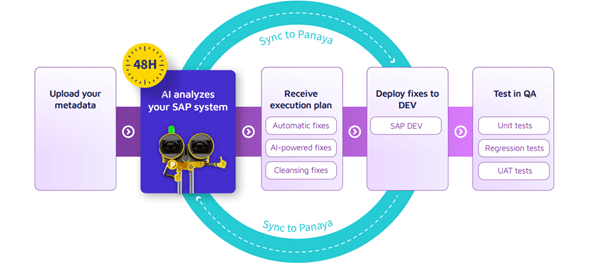
With Panaya, organizations gain a migration experience built on precision, predictability, and trust:
- Remove the Guesswork: get a tailored project blueprint that shows what to correct, how to test it, and the exact order of execution, all mapped to your production codebase.
- Mitigate Risk with AI-driven Impact Analysis: understand the real impact of every change across business processes, code, and integrations.
- Eliminate Scope Confusion: use risk-based testing and automated code fixes to focus effort on what matters and avoid unnecessary rework.
- Accelerate Test Execution and Time-to-Value: structured UAT, automated test plans and “pass-the-baton”, leveraging manual tests and a no-code approach to accelerate automation.
See how Panaya’s Platform helps organizations accelerate S/4HANA migrations while reducing cost, risk, and disruption.
Key Takeaways
- Move before ECC sunsets in 2027: S/4HANA delivers modern performance, real-time analytics, and long-term SAP support. Waiting increases cost, risk, and resource constraints.
- Expect major improvements in speed, efficiency, and insight: S/4HANA’s in-memory architecture, simplified data model, and modern UI/UX enable faster processing, operational agility, and access to advanced technologies like AI and process automation.
- Prepare for common migration challenges: issues such as data quality, customization compatibility, integration dependencies, testing volume, talent shortages, and timeline pressure can slow projects if not addressed early.
- Choose the right migration strategy: Greenfield (new implementation), Brownfield (system conversion), and Landscape Transformation each offer distinct benefits and trade-offs. The right choice depends on your processes, landscape, and readiness for change.
- Follow proven best practices: thorough planning, landscape assessment, data preparation, extensive testing, stakeholder communication, and re-evaluation of legacy customizations all contribute to a smoother migration.
- Leverage Panaya to reduce risk and uncertainty: with impact analysis, intelligent code correction, usage-based scoping, and SAP-focused test automation, Panaya gives teams a clearer path to a fast, predictable, and disruption-free migration.
- Expect clarity, speed, and confidence: Panaya helps organizations deliver migrations with structured plans, real-time risk understanding, efficient test execution, and minimized scope confusion.
Conclusion
Migrating to SAP S/4HANA is more than a system upgrade, it is a structural shift in how organizations operate, innovate, and deliver value. The timelines are fixed, the talent market is tightening, and the longer teams wait, the more constrained and costly the journey becomes.
Yet with the right preparation, visibility, and approach, S/4HANA migration does not need to be disruptive. Understanding your landscape, choosing the right strategy, preparing your data, and structuring testing early all play a defining role in project success. The organizations that do this well enter S/4HANA not just with a new ERP, but with a stronger foundation for automation, analytics, and future innovation.
And while the complexity is real, so is the opportunity: a cleaner core, streamlined processes, modern user experiences, and the ability to run at the speed your business now demands.
If you’re ready to take the next step and build a migration plan grounded in clarity and confidence, explore the expert guidance in “The Show Must Go On: How to Achieve Zero Business Disruption in Your SAP Project”
Frequently Asked Questions