

Table of Content
The 2025 SAP Development Challenge
Delays or Go-live with errors in your S/4HANA migration, and the consequences will be costly and time-consuming. Every SAP manager knows the risk, but with 61% of ECC customers still not licensed for S/4HANA as of late 2024, the clock is ticking, the pressure to migrate is growing, and custom ABAP code remediation remains a key migration bottleneck that is holding businesses back.
SAP ERP is the backbone of global enterprises, powering finance, supply chain, HR, and operations. It processes the transactions that keep the business alive and supports the strategies that drive it forward, so any disruption to the essential functions it delivers isn’t just inconvenient; it’s a crisis.
Consider how a real-world scenario unfolded for a global manufacturer: On go-live day for its S/4HANA migration, orders from its largest customer began failing. Production lines were halted, sales couldn’t book shipments, and service tickets poured in. The cause? A decades-old ABAP function that was incompatible with S/4HANA turned a fixable issue into a three-day scramble that cost millions and damaged client trust. The CIO was ultimately held accountable for this costly failure.
After decades of ECC, many enterprises are now buried under layers of custom ABAP code and legacy logic, much of which is undocumented, with the original developers long gone. This code supports essential processes, but it’s fragile, opaque, and often redundant.
Custom code makes up 40% of migration work, and every line needs to be scoped, cleaned, and aligned with S/4HANA. For most teams, this is still a manual, time-consuming, and risky process, where missed issues can easily delay go-lives, cause defects, and threaten business continuity.
Introduction: What Are Automatic Code Corrections?
Automatic code corrections are designed to analyze custom ABAP code, identify incompatibilities or inefficiencies, and apply safe fixes automatically or with minimal developer review. At Panaya, this capability is delivered through its Automatic Code Corrections (ACC) offering. Panaya ACC not only auto-corrects syntax incompatible with SAP S/4HANA. It also safely deactivates unused and obsolete custom code. This reduces technical debt and project scope and also ensures alignment with SAP Clean Core principles.
ABAP Examples
Three common types of code corrections required during ECC to S/4HANA migration include:
- Outdated SELECT statements that do not comply with HANA optimization rules and can impact performance.
- Incorrect use of MATNR fields, due to the change in field length from 18 to 40 characters in S/4HANA.
- Obsolete or hardcoded logic, including functions that are deprecated or incompatible with the new system.
Panaya detects these issues and automatically suggests the appropriate corrections, all mapped to SAP best practices and simplification items.
What You’ll Learn
- What Automatic code correction is and how it works
- Why ACC is essential for S/4HANA migrations, upgrades, and compliance
- How Panaya automates code fixes with speed, accuracy, and safety
- Where AI fits into SAP code fixes through Seemore, Panaya’s AI-powered ABAP agent
- What sets Panaya apart from SAP’s standard toolset
Firstly, let’s look at how Panaya automates what SAP leaves unfinished.
SAP Flags It. Panaya Fixes It.
During the S/4HANA brownfield migration process, SAP identifies what’s broken but stops there. Then, it’s up to the teams to figure out how to fix this custom code, line by line. Panaya lifts much of this burden by scoping and automating custom code corrections at scale and by reducing correction time by up to 90%. For the last 10% of more complex or ambiguous cases, Seemore analyzes the context, applies SAP best practices, and provides safe, targeted fixes that can be implemented after review.
Why Are Automatic Code Corrections a Game Changer for SAP Teams?
Manual corrections slow everything down, including projects, teams, and business momentum. In SAP, where timelines are tight and errors are expensive, massive amounts of code corrections can make or break a migration timeline, so it’s good to know that tasks that once took months now take days. Work that previously required manual ABAP development can now be Automatic on a large scale. For SAP teams under pressure, that means ACC is no longer a nice-to-have; it’s a strategic advantage.
Why Does Automatic Correction Change Everything?
Speed: Cut Correction Time from Months to Weeks
Time is the first casualty in manual code remediation. Projects drag on, teams get stuck in review cycles, and project timelines slip. Automatic code correction compresses migration timelines, so what used to take months now takes just two to four weeks. Panaya generates a fix plan in 48 hours and speeds up implementation with auto-correction deployments.
Accuracy: Deploy with Confidence
Each correction is validated against SAP best practices, reducing the risk of errors. This assurance is strengthened by Panaya’s deep domain expertise, built over 20 years, and thousands of customer SAP projects. Our customers consistently report high satisfaction with their projects and rate Panaya as a trusted leader on G2.
Scalability: Handle Thousands of Code Objects at Once
ACC enables teams to handle thousands of code objects in parallel, regardless of system size or complexity.
Productivity: Free Developers for Strategic Work
Automating manual fixes and cleansing work, including removing unused or outdated custom code, frees developers from repetitive reviews and manual corrections so they can focus on more strategic areas. At the same time, developers, testers, and business users can work together on a single SaaS platform, improving communication across teams and accelerating decision-making.
Automatic Code Correction: Business Use Cases
Migration from ECC to S/4HANA
Decades of custom code now incompatible with S/4HANA turn manual corrections into a massive bottleneck. Automatic code correction solves this by analyzing the codebase, applying safe, standards-aligned fixes, removing unused components, and tracking every change to completion.
Panaya’s AI-Based and Automatic Code Corrections
Built-in Impact Analysis
Automatic code correction is part of a larger migration or upgrade process. Impact analysis is the foundation of effective SAP change management, revealing exactly what will break, what to fix, and what to test before any change begins. Panaya’s Impact Analysis provides complete visibility into your SAP landscape before you make a single change.
Within 48 hours, teams receive a detailed pre-conversion assessment that identifies both technical and functional risks. It shows usage data to distinguish actively used code in production from outdated components that can be safely turned off. It detects issues that could cause failures during migration or after go-live. It highlights test coverage gaps where essential business processes are not fully validated, and it also flags compatibility issues across add-ons, custom code, and enhancements that may not meet S/4HANA requirements. The result is a clear, actionable migration plan that outlines what will break, what needs fixing, and what must be tested. Panaya provides an accurate project scope and helps prevent surprises downstream.
Panaya: Enabling Smart Code Corrections
Once the blueprint is in hand, showing exactly what needs to be done, the next step is execution by priority. This is where ACC takes over to accelerate delivery and move teams quickly toward testing.
Suggested Code Fixes Based on Best Practices and AI
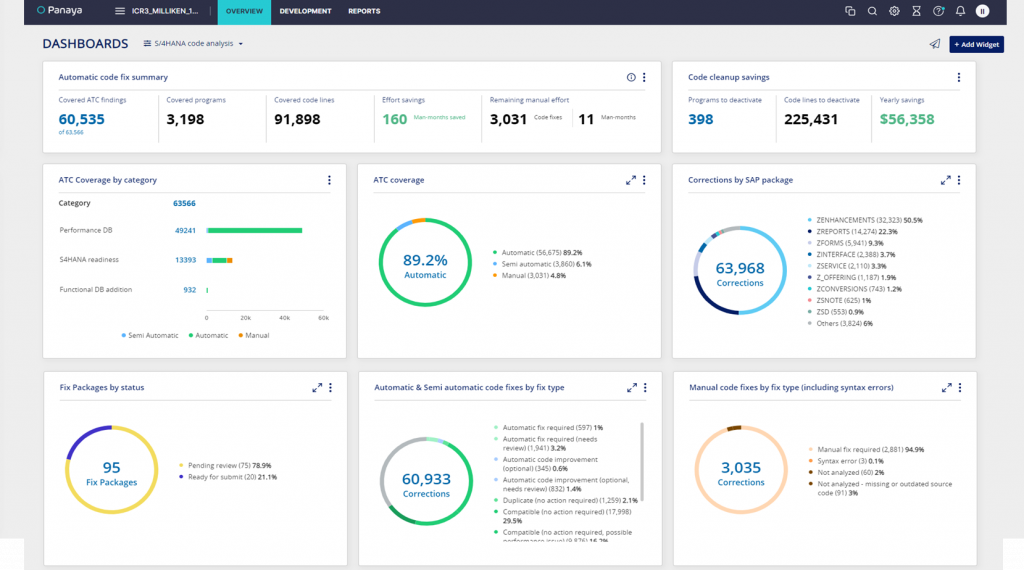
With Panaya, code corrections are handled in a controlled and transparent process. The platform automatically generates the necessary fixes. Changes can be accepted and directly deployed into the SAP transport process, ensuring accuracy and seamless integration into existing workflows.
The execution plan from the impact analysis includes three types of corrections:
Automatic Code Fixing: Applies SAP-aligned corrections at scale using a rules-based engine that supports multiple SAP versions and release targets. Fixes are grouped into smart packages based on issue type, then applied and deployed through a dedicated cockpit with complete visibility and rollback control. Each change is documented, context-aware, and audit-ready.
Automatic Code Cleansing: Removes unused or obsolete custom code based on actual usage. By reducing technical debt upfront, it cuts the number of objects that need testing or fixing, shrinking project scope and speeding up delivery. Cleansing runs in simulation mode first, allowing teams to review and approve all changes before deactivation, and code is deactivated rather than deleted, making the process fully reversible. Cleansing status is tracked throughout.
Seemore, Panaya’s AI-powered Assistant: When dealing with more complex coding issues, Panaya’s AI-powered Seemore analyzes business logic, code context, and SAP guidelines to suggest safe, relevant corrections. Developers interact with Seemore in natural language to review, adjust, and explain desired fixes. Each recommendation is backed by SAP Notes and project history, turning manual corrections into a fast, guided workflow that improves speed, safety, and code quality. AI-powered code remediation tools like Seemore can accelerate the most complex code corrections, delivering these changes more efficiently.
Integration with DevOps and Testing Workflows
Unlike modern DevOps environments that support agile sprint cycles, SAP landscapes often rely on slower, transport-based workflows. Panaya bridges this gap by integrating automatic code correction directly into the SAP transport process. All corrections, whether automatic or AI-assisted, are packaged for safe and auditable deployment through your existing SAP landscape. This ensures that changes align with transport sequencing, reduce deployment risk, and support both agile delivery models and traditional SAP operations without disruption.
This DevOps alignment is where many other tools fall short. SAP Quick Fixes are limited to basic rule-based fixes without transport awareness. The table below compares how Panaya integrates automatic and AI-assisted corrections directly into SAP transport and delivery pipelines, offering clear benefits in speed, control, and operational compatibility compared to other solutions.
| Panaya | SAP Quick Fixes | smartShift | |
| Best For | Fast, low-risk SAP fixes and migration | Minor fixes post-conversion | ECC to S/4HANA migration |
| Onboarding | SaaS, 1 hour setup, 1 day onboarding | Heavy Eclipse/Fiori installation | On-premises setup |
| AI and Automation | Full automation and an AI assistant for more complex issues | Basic, manual rule application | Automatic, but black-boxed |
| Code Cleansing | Full: usage-based | None | Full |
| Visibility and Control | Full tracking + rollback | Minimal | None |
| Transport Integration | Built-in | Manual handoff | Manual handoff |
| Project Management Capabilities | Built-in flow, guidance, and testing integration | No project flow | None |
| Delivery Model | Internal IT or System Integrator-led | Internal IT or System Integrator-led | Offshore-led service only. |
What Customers Say About Panaya Automatic Code Corrections
“From enabling automatic code corrections to facilitating fast and efficient change impact analysis, Panaya has proven to be an invaluable partner.”
Muhammad Amod, Head of IT Application Services, Senwes | Read the full story
“What we liked most about Panaya is that it allows us to do the upgrades and saves us about 40% of the time and cost, which allows us to do more projects in half the time.”
Albert Lopez Garcia, SAP IT Manager, REPSOL | Watch the full story
Conclusion: Future-Proof, Resilient, and Scalable SAP Development Practices with Panaya
In SAP, change is constant. New ERP versions and changes to standard functionality can reshape business operations and workflows. Delays in upgrades and migrations impact business priorities, innovation needs, and damage customer trust. Panaya’s Automatic Code Corrections (ACC) replaces code risk with a controlled, automatic process that provides speed, accuracy, and alignment with SAP best practices.
By integrating impact analysis, automatic code cleanup, and AI-driven corrections, Panaya offers an end-to-end solution that minimizes risks in the migration from ECC to S/4HANA, speeds up timelines, and enforces Clean Core compliance.
With 20 years of SAP expertise and thousands of successful customer projects, Panaya guarantees that every change, from migrations to upgrades and enhancements, is a controlled and strategic move that protects business continuity and creates lasting value. For SAP leaders seeking resilience, compliance, and speed, the next step is clear: explore how Panaya can turn every change into a strategic advantage.
Key Takeaways
- Reduce S/4HANA migration delays with automatic code fixing that cuts correction time by up to 90%.
- Cut technical debt by safely deactivating unused or obsolete ABAP code without deleting it.
- Ensure Clean Core compliance with SAP best-practice-aligned automatic fixes.
- Eliminate manual fixes for many issues with AI-powered, context-aware corrections.
- Connect risk detection to resolution using built-in impact analysis for precise project scoping.
- Deploy with confidence through fully auditable, reversible changes.
Frequently Asked Questions